The shared wallet concept.
How multiple businesses share one platform while staying invisible to each other.
The core insight: Customers sign up once (or join as a guest if enabled) and can collect loyalty programs from any participating business on the same installation. Each business sees only their own data. This is shared infrastructure. Nothing appears in public unless you choose to feature it.
The shared wallet is the architecture underneath every homepage layout. A single-brand Showcase, a sign-in-only Portal, a curated Smart wallet, and a searchable Public listing all run on the same isolated-partner foundation. The layout changes what visitors see first; it does not change account sharing or partner isolation.
The problem with traditional loyalty platforms
Most loyalty software forces a choice:
Option A: Isolated installations. Each business gets their own separate system. Customers create new accounts everywhere they go. Setup costs multiply with every client.
Option B: Public directories. Businesses appear in a searchable listing. A directory with three entries looks empty, the brand associations are uncontrolled, and competitors refuse to share a page. The cold start kills adoption.
The shared wallet takes a third approach.
How the shared wallet works
One account, many programs
When a customer signs up at any participating business, they create a single account. That account works everywhere:
- Coffee shop gives them a stamp card
- Gym next door has a points program
- Restaurant downtown uses the same system
The customer signs in once (email OTP by default; password optional). Their wallet can contain cards from every business they've visited, with no separate accounts per business.
graph TD
    M["One member, one sign-in"] --> W["One wallet"]
    subgraph PA["Coffee shop (Partner A)"]
        CA["Stamp card"]
    end
    subgraph PB["Gym (Partner B)"]
        CB["Points card"]
    end
    W --> CA
    W --> CB
The wallet crosses business boundaries; the businesses never do. Partner A and Partner B each see their own card, their own transactions, and nothing of each other.
Complete partner isolation
Each business, called a Partner, operates in total isolation:
| What partners see | What partners don't see |
|---|---|
| Their own loyalty cards | Other partners' cards |
| Their own customers | Other partners' customers |
| Their own transactions | Platform-wide activity |
| Their own analytics | Who else uses the system |
| Their own staff | Other partners' staff |
When a partner signs in to the Partner Dashboard, they see their own data within the platform's interface. The platform carries the branding of whoever operates the installation: your logo, your domain. The data is theirs: their cards, their customers, their transactions. No indication that anyone else exists.
The server enforces this isolation (tenant scoping + authorization checks), not the UI alone. Partners cannot access each other's data.
Why this matters
The shared wallet removes the problems that stall other loyalty platforms:
No cold-start problem. There's no directory to look empty. You pitch each business as their own system, because from their perspective, it is.
No brand conflicts. A fine dining restaurant and a fast-food chain can use the same installation. Neither sees the other. Neither needs to approve the association.
Reduced signup friction across businesses. If a customer already has an account on your installation, they won't need to create a new account when they later discover another participating business.
One installation, unlimited partners. You manage one server, one database, one update process. Your clients each get a complete loyalty system.
Two levels of branding
Branding splits into two layers, and each serves a different audience.
Platform branding (yours)
The installation owner (you, the script purchaser) controls the platform's look and feel:
- Logo in the header
- Platform name and domain
This is customizable without touching code. When partners sign in, they see your platform. When customers use the app, they see your brand.
Card branding (theirs)
Each partner brands their own loyalty cards:
- Card images and backgrounds
- Reward descriptions and terms
- Business name and contact info
- QR codes and promotional materials
A partner can have multiple cards, each with different designs. A coffee shop might have a stamp card with one look and a points-based loyalty card with another.
The result
| Element | Who Controls It |
|---|---|
| Dashboard interface | Platform owner |
| Login pages | Platform owner |
| Loyalty card design | Individual partner |
| Stamp card design | Individual partner |
| Rewards and offers | Individual partner |
| Business profile | Individual partner |
Platform operators build a cohesive product identity. Partners customize what matters to their customers: the cards themselves.
The agency advantage
If you're selling loyalty programs to multiple clients, this architecture is what makes the business model work.
The pitch that converts
You approach a high-end restaurant. You show them:
- A professional partner dashboard with your platform branding
- Their loyalty cards featuring their logo, colors, and design
- Their customers, their analytics, their control
- No mention of anyone else
They see a premium loyalty system. They agree to a monthly fee.
Next week, you approach a local gym. Same pitch, same platform interface, different login, different cards with the gym's branding.
Both businesses are on your single installation. Both sign in to the same platform (with your branding), but each sees their own data and manages their own branded cards. The platform is yours; the loyalty programs are theirs.
If instead you showed that restaurant a public directory containing a kebab stand and an auto repair shop, they would decline. No one wants to be entry three on a sparse directory, associated with businesses that don't match their market position.
The math works
Consider the traditional model:
- 10 clients × separate installations = 10 servers to maintain, 10 updates to apply, 10 databases to backup, 10 SSL certificates to renew
Now consider the shared wallet:
- 10 clients × one installation = 1 server, 1 update, 1 database, 1 SSL certificate
- Same monthly revenue, fraction of the overhead
With a single license, you can run unlimited partners on a single installation. The Partner Permissions system lets you control which features each partner can access.
The customer experience
The shared wallet creates value for every participant.
Zero-friction engagement
A customer signs up at a coffee shop. Standard process: email, verification code, done. They start collecting stamps.
A month later, they visit a gym that uses the same platform. They see a QR code at the counter and scan it.
If they're already signed in on that device, they go straight to the gym's loyalty program.
If they're not signed in, they can sign in (or sign up) with an email OTP code, or use guest/anonymous mode if that installation has it enabled.
Either way, it's one account for the platform. The gym becomes another card in the same wallet.
The practical "network effect"
The app doesn't pool points across businesses. It does reduce signup friction:
- Customers keep one wallet and can add many business programs to it
- Businesses benefit when customers already have an account on the same installation
Exact overlap depends on geography and customer behavior, so we avoid publishing fixed "recognition rate" percentages.
What customers see
The Member Dashboard shows customers all their collected cards in one place:
- My Cards: Every loyalty card, stamp card, and voucher they've collected
- Points balances: Tracked per business
- Available rewards: What they can redeem where
- Transaction history: Full activity log
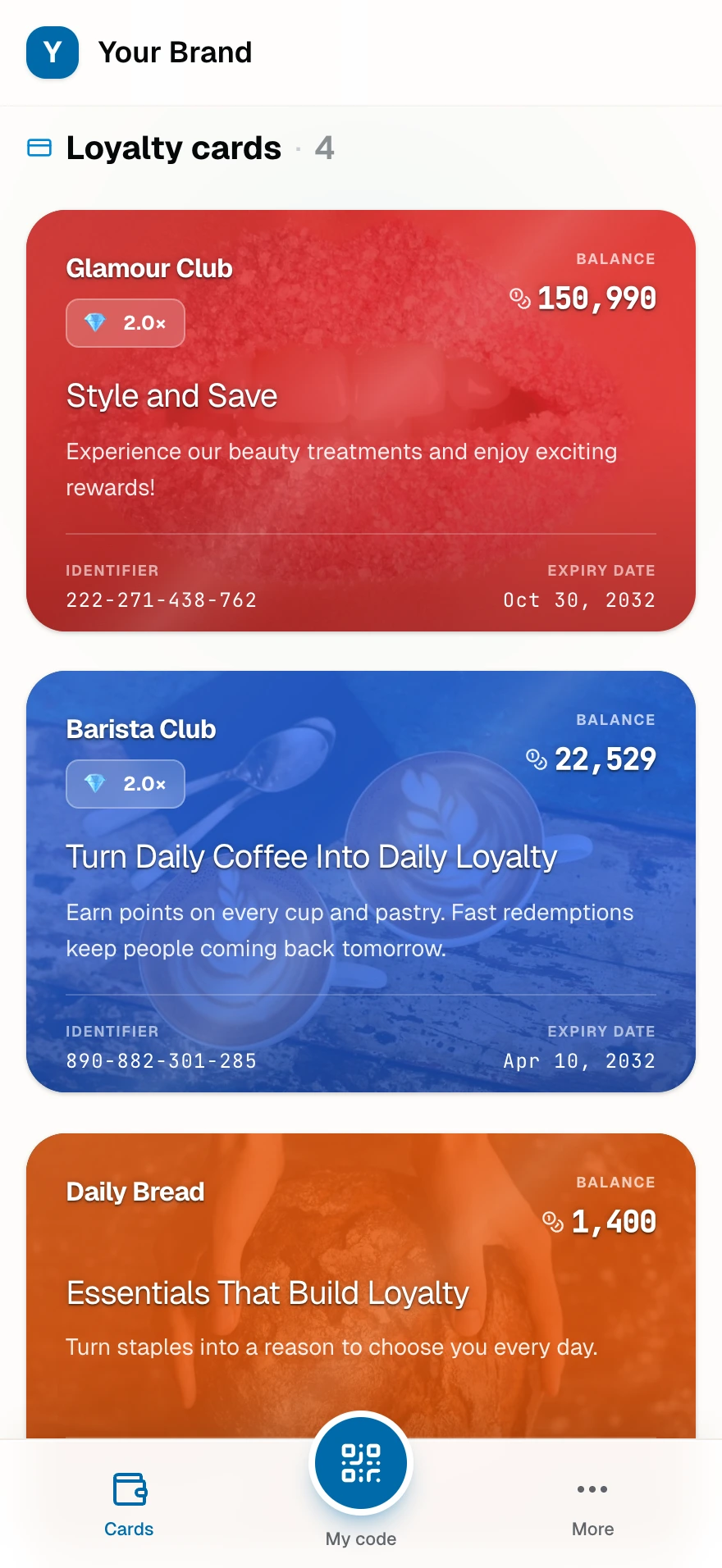
Customers never see which businesses share infrastructure. They experience a unified wallet that works everywhere.
Why no automatic directory?
The app supports public discovery and never adds every partner on its own. Partners are isolated, and nothing appears in public unless you choose to feature it. When discovery is part of the business model, the Public listing homepage provides a searchable, filterable directory of approved programs. The permission stack controls every entry, so partner isolation stays intact.
This distinction matters: no automatic directory does not mean no public listing. It means the operator controls when the directory launches, which partners may participate, and which programs each partner publishes.
The empty directory problem
A directory with three listings looks worse than no directory at all. It signals a new, struggling platform and makes a business ask whether their customer data is safe here. You need critical mass before a listing adds value, and early entries that look amateur keep you from ever reaching it.
Brand association risk
Businesses guard their image. A luxury spa doesn't want to appear alongside a discount oil change shop. A vegan restaurant doesn't want to be listed next to a steakhouse.
With partner isolation, you can onboard any business without asking permission from existing partners. Nobody needs to approve who else uses the platform.
But you can curate a homepage
This doesn't mean partners must remain invisible to customers. Three of the four homepage layouts can feature programs: Smart wallet as a curated wallet, Showcase as an editorial page, and Public listing as a searchable directory. Portal shows no public catalogue. Whichever public mode you pick, the same rules apply:
- Admin grants permission: You decide which partners can publish to the homepage
- Partners choose what to show: Those with permission decide which programs to display
- You control associations: Only partners you've approved appear together
Smart wallet is often strongest for one business with several campaigns or a small, intentional group of complementary businesses. Public listing suits marketers and operators who want visitors to search across a broader network. Showcase leads with one brand. Agencies whose unrelated clients should not appear together should start with Portal. These are different public-entry strategies for the same shared-wallet architecture.
| Homepage | Public programs? | Best use |
|---|---|---|
| Smart wallet | Yes, curated | One business or an intentional partner collection |
| Showcase | Yes, curated | A single brand or campaign-led landing page |
| Portal | No | Agencies, QR-first access, or an app behind another website |
| Public listing | Yes, searchable | Marketers, destinations, associations, and discovery networks |
The difference from an automatic directory:
| Automatic directory | Curated listing (ours) |
|---|---|
| Every business appears the moment it joins | You grant permission per partner |
| Cold-start problem (3 listings looks bad) | Start empty, add when ready |
| Uncontrolled brand associations | You choose who appears together |
| Search forced on a sparse, auto-filled list | Search and filters are opt-in, over a list you curated |
You get partner isolation by default for clean sales pitches, with the option to showcase a curated network when it benefits the customer experience.
Partners still prefer isolation by default
Agencies selling to multiple clients tell us they prefer the current model. Their clients don't want to know who else uses the system. The invisibility is a feature.
When you've curated high-quality partners who complement each other, the homepage becomes a strength, showing customers the network value of one account across multiple businesses.
How customers find businesses
Without a central directory, customers find a program the way loyalty has always worked: the business tells them.
- QR code at the counter
- Sign by the register
- Link in their email footer
- Widget on their website (Shopify widget available) or a connected WooCommerce store
- Card in the receipt
When a customer scans that QR code:
- If they're already signed in on that device → instant access
- If they're new (or signed out) → quick signup/login via OTP (or guest mode, if enabled)
- Either way → connected to that business's loyalty program
Each business promotes their own program to their own customers. They don't rely on platform discovery. They own their customer relationships.
Use cases this architecture enables
Agency / marketing consultancy
Sell loyalty programs as a managed service. Each client gets a Partner account. You maintain the installation and charge monthly fees.
How it works:
- One licensed installation
- Create a partner for each client
- Set permissions and limits per partner
- Bill clients through your existing invoicing process
Why the shared wallet helps: Clients in the same area share customers. If a customer already joined one client on your installation, they won't need to create a second account to join another client's program.
Multi-brand business
Run several brands that shouldn't cross-promote. Different price points, different target markets, different identities.
How it works:
- One installation
- One partner per brand
- Separate logins, separate dashboards
- Customers can use one account across brands (if they discover them on their own)
Why the shared wallet helps: Your brands stay distinct while customers benefit from account portability. Someone shopping at your premium boutique can use the same login at your outlet store without you connecting the brands.
Franchise network
Corporate provides the loyalty infrastructure. Franchisees manage their own programs.
How it works:
- Corporate controls the installation
- Each franchisee gets a partner account
- Networks group franchisees by region
- Standard loyalty card templates with local customization
Why the shared wallet helps: A customer who visits any franchise location can use the same account everywhere. Same wallet, one login, with balances tracked per location and program.
Business association / shopping district
Provide loyalty as a member benefit. Shopping centers, downtown associations, cooperative groups.
How it works:
- Association operates the installation
- Member businesses get partner accounts
- Optional shared branding ("Downtown Rewards")
- Billing through existing membership dues
Why the shared wallet helps: Customers shopping the district create one account and can add many member-business cards to one wallet. The association can demonstrate this convenience to attract new members.
White-label SaaS provider
Offer "your own" loyalty platform to clients who never know what powers it.
How it works:
- Your branding on the platform itself
- Your domain, your identity
- Partners create their own branded loyalty cards within your platform
- Manage partner plans with the built-in plan tier system; invoice through your own accounting, or turn on Stripe or PayPal
Why the shared wallet helps: Customers see a unified experience across all your clients. Partners each manage their own branded cards. You benefit from reduced signup friction across your client network.
Technical foundation
The shared wallet is possible because of how the app handles data:
Multi-tenant architecture
Every piece of partner data is scoped:
graph LR
    A["Partner"] --> B["Clubs"]
    B --> C["Cards"]
    C --> D["Transactions"]
    B --> E["Staff"]
    A -. "relationship,\nnot ownership" .-> F["Members"]
When a partner queries data, they only receive records linked to their account. The database holds every customer, but each partner sees only their own: the customers who have interacted with them, and the registered members who hold one of their cards without having used it yet. A partner never sees another partner's customers or activity.
Member relationships, not ownership
Customers ("Members") exist at the platform level, not the partner level. When a customer collects a card from a business, a relationship is created:
- Customer exists in system
- Customer collects Card A from Partner A
- Customer collects Card B from Partner B
- Partner A sees customer with Card A data only
- Partner B sees customer with Card B data only
- Customer sees both cards in their wallet
Neither partner "owns" the customer. They each have a relationship with that customer for their specific loyalty program.
Privacy by design
- Partners cannot enumerate customers they don't have relationships with
- Transaction history is scoped to the viewing partner
- Analytics aggregate only the partner's own data
See User Roles for the complete permission structure.
Common questions
"Can partners share customers or run cross-promotions?"
Not by default. The isolation protects partners from unwanted associations. If you want to enable specific cross-promotions between partners, you'd need custom development. This isn't a built-in feature.
"What if two partners have the same customer?"
Both partners see that customer in their customer list, but each sees data relevant to their own loyalty program. Partner A sees their transactions and points balance. Partner B sees different data. Neither knows the customer visits the other.
"Can I see all customers across the installation?"
Administrators can. Partners cannot. The Admin dashboard provides platform-wide analytics and customer data. Individual partners only see their slice.
"Is this the same as multi-tenancy?"
Yes. The shared wallet is our application of multi-tenant architecture to loyalty programs. Each partner is a tenant with isolated data access sharing common infrastructure.
"What about GDPR and data privacy?"
Customer data belongs to the platform, with access controlled by relationships. When a customer deletes their account, their data is removed from all partner relationships. Individual partners can remove their relationship with a customer without affecting other partners.
Summary
| Traditional approach | Shared wallet |
|---|---|
| Separate installation per client | One installation, unlimited partners |
| Customer creates account everywhere | One account for all programs on the platform |
| No account reuse between businesses | Customers can add multiple programs to one wallet |
| Directory needed for discovery | No directory required (partners are isolated by default) |
| Brand association concerns | Complete partner isolation |
| Manual customer data migration | Single member identity across programs (no migration step) |
The shared wallet is the architecture that works for agencies, franchises, associations, and anyone serving multiple businesses.
Next steps
- Who Is This For?: Business models and monetization strategies
- Homepage layouts: Choose and configure the public entry point
- Smart wallet homepage: Present one business or a curated network through its cards
- Showcase homepage: Build a brand-led loyalty landing page
- Portal homepage: Keep the homepage focused on access
- Public listing homepage: Build an opt-in public discovery directory
- Platform Branding: Customize your installation's look and feel
- User Roles Explained: Understanding partners, staff, and customers
- Partner Permissions: Controlling what each partner can access
- Networks & Organization: Grouping partners for management
- Try the Demo: See partner isolation in action