Technology stack.
The technologies, frameworks, and architecture decisions behind Reward Loyalty.
Reward Loyalty is a Laravel application. If you've worked with Laravel before, the codebase will feel familiar: Eloquent models, Blade templates, Form Requests, resource controllers, and database migrations.
Stack overview
| Layer | Technology |
|---|---|
| Language | PHP 8.4.1+ |
| Framework | Laravel 13 |
| Frontend | Tailwind CSS v4, Alpine.js v3 |
| Build Tools | Vite, NPM |
| Database | MySQL 5.7+, MariaDB 10.3+, or SQLite 3.26+ |
| Authentication | Passwordless OTP (email-based) |
| API | REST + OpenAPI 3.0 (Swagger) |
| PWA | Service Worker, Web App Manifest |
Backend
The application runs on PHP 8.4.1 or newer with Laravel 13. The codebase follows the standard Laravel layout: controllers in app/Http/Controllers, business logic in app/Services, Eloquent models in app/Models, and jobs, events, and observers in their usual app/ directories. There is no custom module system to learn.
Frontend
Tailwind CSS v4 handles styling. Alpine.js v3 handles interactive behavior. Pages are server-rendered Blade templates, with Alpine.js managing client-side interactions like modals, dropdowns, and form validation.
Vite compiles assets and provides hot module replacement during development.
Database
Reward Loyalty supports three database engines:
- MySQL 5.7+, recommended for production
- MariaDB 10.3+, a compatible alternative
- SQLite 3.26+, suitable for development and small deployments
Multi-tenant architecture
Partner dashboard and API operations restrict private business records to the authenticated partner. Administrators have broader installation access. Members can collect programs from several businesses, while each business sees its own relationship and transactions.
A single installation can serve unlimited businesses. See The Shared Wallet Concept for how this architecture enables business networks.
API layer
Two API surfaces are available:
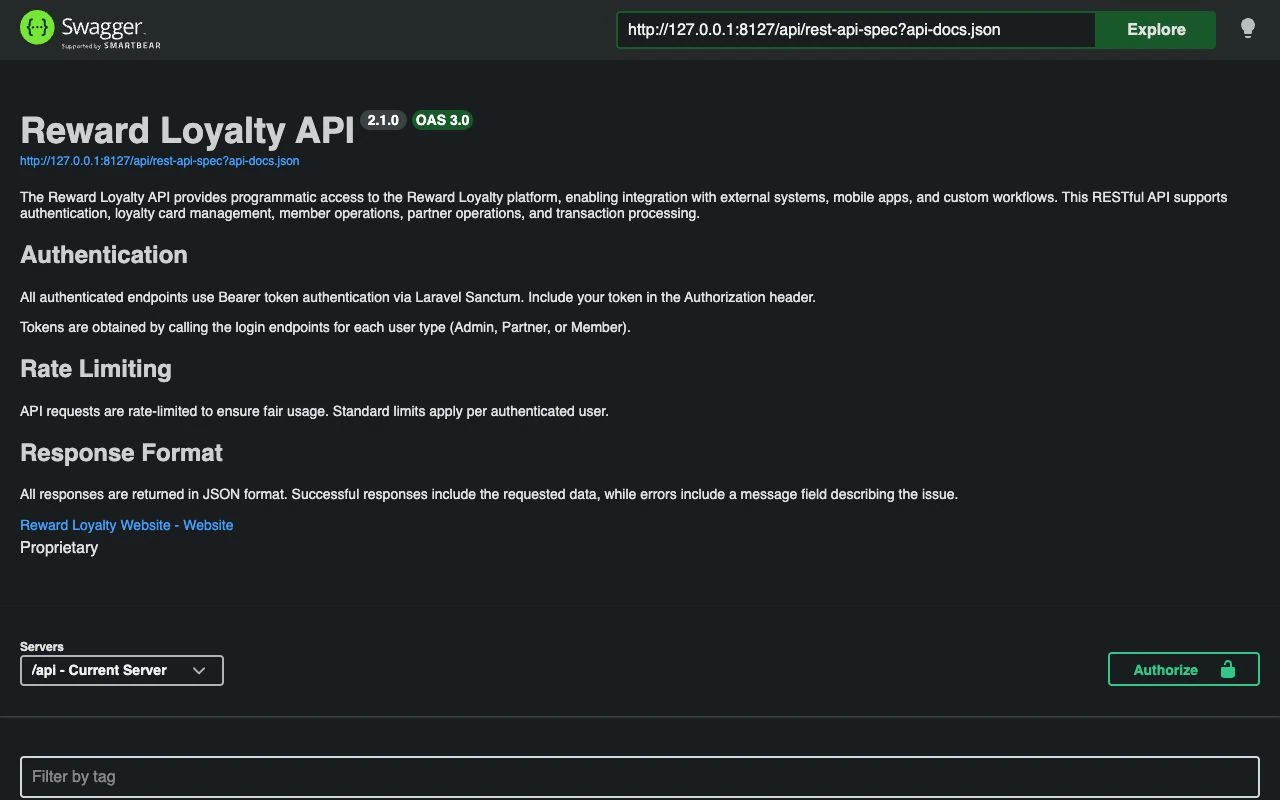
- REST API, token-authenticated endpoints for POS integrations and external systems. Swagger documents them at
/api/documentation. - Agent API, a machine-to-machine protocol for AI agents and automation tools. OpenAPI 3.0 spec with tool discovery for OpenAI, Anthropic, and MCP formats. See Agent API Documentation.
Source code
Every license includes the complete, unobfuscated source code. No encrypted files, no compiled binaries. You can read, modify, and extend any part of the application.
For server requirements and PHP extensions, see Requirements.