Understanding discount types.
Choose the right discount type for your campaign (percentage, fixed amount, free product, bonus points).
Every voucher needs a discount type. It determines how customers benefit and how the discount is calculated at checkout. Vouchers support four discount types, each suited for different marketing goals.
| Type | What It Does | Best For |
|---|---|---|
| Percentage off | X% off the order | General promotions, scaling discounts |
| Fixed amount off | A set amount off the order | Minimum purchase incentives |
| Free product | A named item free | Product trials, add-ons |
| Bonus loyalty points | Points credited to the member's loyalty card | Loyalty engagement |
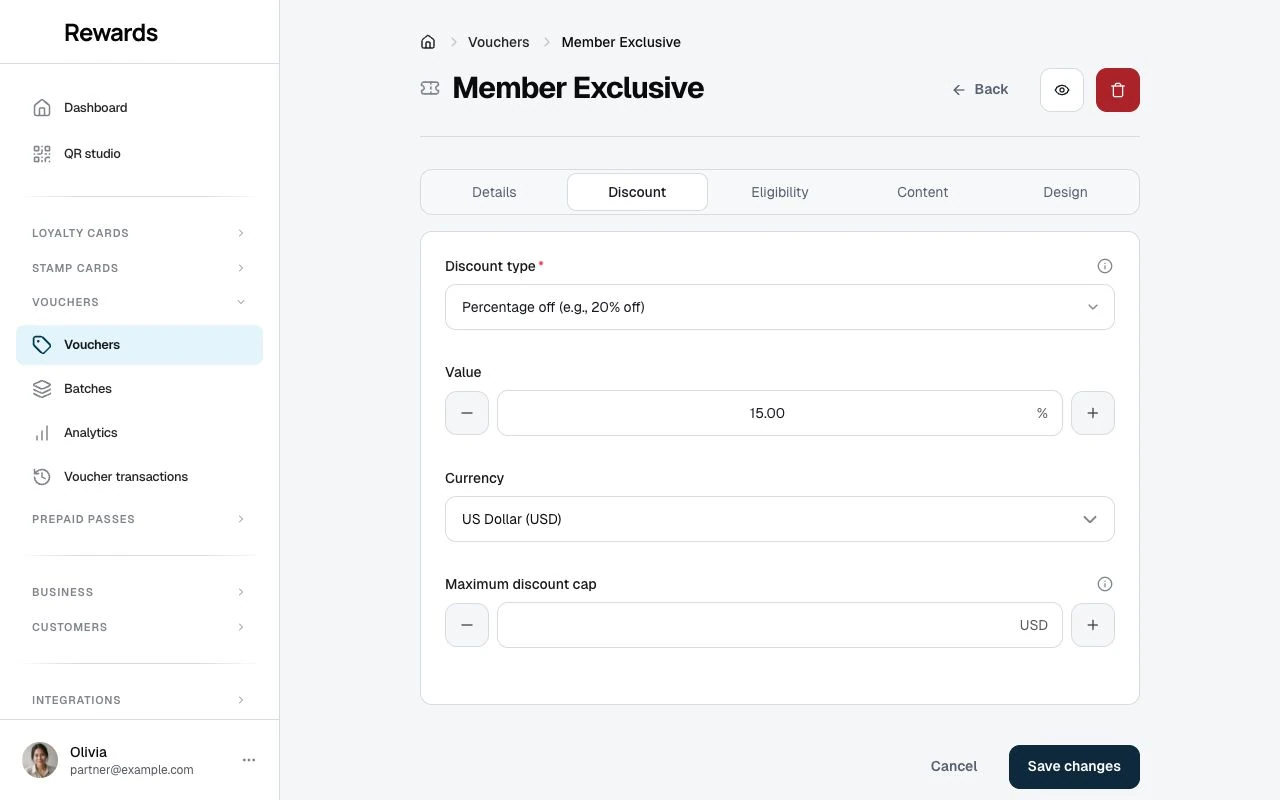
Percentage discount
Take a percentage off the order total.
How it works
Customer order total × discount percentage = discount amount
Example:
- Voucher: SUMMER20 (20% off)
- Order total: $80.00
- Discount: $16.00 (20% of $80)
- Customer pays: $64.00
When to use
- Seasonal sales (20% off summer sale)
- Storewide promotions (15% off everything)
- Tiered campaigns (10%, 15%, 20% for different tiers)
Maximum discount cap
Protect your margins on large orders by setting a cap in your chosen currency.
Example: 20% off with $50 maximum cap
- $100 order → $20 discount (20%)
- $300 order → $50 discount (capped, not $60)
- $400 order → $50 discount (capped, not $80)
Without a cap, percentage discounts can get expensive on high-value orders.
💡 Currency: When you set a maximum cap, select the currency that matches your business. Enter the cap as a normal amount (e.g., 50.00 for a 50.00 cap).
Examples
| Voucher | Order Total | Discount | Final |
|---|---|---|---|
| 10% off | $30 | $3.00 | $27.00 |
| 20% off | $50 | $10.00 | $40.00 |
| 25% off (max $20) | $100 | $20.00 | $80.00 |
| 25% off (max $20) | $50 | $12.50 | $37.50 |
Best practices
- Popular percentages: 10%, 15%, 20%, 25%
- Avoid odd numbers: 17% feels random; 15% or 20% feels intentional
- Always consider caps: Protect against unexpectedly large orders
- Pair with minimums: "20% off orders over $50" increases basket size
Fixed amount discount
Subtract a specific amount from the order in your chosen currency.
How it works
Order total − fixed amount = customer pays
Example:
- Voucher: SAVE10 ($10 off)
- Order total: $45.00
- Discount: $10.00
- Customer pays: $35.00
If the order is less than the discount, customer pays $0 (discount doesn't exceed order).
Currency setting
When creating a fixed amount voucher, select the currency that matches your business. Enter the discount as a normal amount (e.g., 10.00 for 10.00 off in your selected currency).
When to use
- Simple, clear value proposition ("$10 off!")
- Acquisition offers ("$15 off your first order")
- Round-number promotions ("$25 off")
Best practices
- Use round numbers: $5, $10, $15, $20, $25
- Match to average order: $10 off works well for $40+ average orders
- Pair with minimums: "$10 off orders over $50" sets a minimum order; calculate your costs before choosing the discount
- Clear messaging: Customers understand the value
Comparison: Percentage vs. fixed
| Order Size | 20% Off | $10 Off |
|---|---|---|
| $30 | $6.00 | $10.00 |
| $50 | $10.00 | $10.00 |
| $100 | $20.00 | $10.00 |
| $200 | $40.00 | $10.00 |
Fixed discounts favor smaller orders. Percentage discounts scale with order size.
Free product
Give away a specific product at no charge.
How it works
Customer receives the named product free when they meet requirements. The product name appears on the voucher itself, so staff and customer both see what the offer covers. There is no item-selection step at redemption: staff redeem the code and hand over the named item.
Example:
- Voucher: FREECOFFEE
- Free product: Medium Coffee
- Minimum purchase: $5.00
- Customer buys $8 sandwich → gets free coffee
When to use
- Product sampling ("Try our new latte free!")
- Bundling incentives ("Free fries with any burger")
- Loyalty rewards ("Free dessert for members")
- Inventory management (move slow-selling items)
Configuration
Free product name (required for this type) Enter the exact item the customer receives. It prints on the voucher, so be specific:
- ✓ "Medium Coffee"
- ✓ "Regular Fries"
- ✗ "Free item"
- ✗ "Beverage"
Minimum purchase (optional) Require a minimum spend to get the free item.
Best practices
- Be specific: "Medium Iced Coffee" not "Coffee"
- Set minimums: Prevent abuse with purchase requirements
- Choose strategically: High-margin items or items you want to promote
- Consider costs: Factor in cost of goods when planning campaigns
Bonus points
Award loyalty points instead of monetary discounts.
How it works
When the voucher is redeemed, points are credited to the member's loyalty card in the voucher's club. The points appear in their balance right away.
Example:
- Voucher: BONUS500
- Points awarded: 500
- Customer redeems → 500 points added to their card in your club
When to use
- Drive loyalty program engagement
- Re-engage lapsed customers
- Reward specific behaviors
- Bridge gap to next reward tier
Configuration
Bonus points (required for this type) Number of points to award (e.g., 500).
Credit points to card (required for this type) Select one of your loyalty cards. This links the voucher to your loyalty program for reference.
Important: At redemption, points go to the member's loyalty card in the voucher's club, not to the card selected here. If the member holds no card in that club, no points are granted; the redemption still completes without them.
No monetary discount
Bonus points vouchers don't reduce the order total. The customer pays full price but receives points as a reward.
Example:
- Order total: $50.00
- Voucher: BONUS500
- Customer pays: $50.00
- Points received: 500
Best practices
- Match point value to engagement: 500 points should feel valuable
- Consider point economics: Ensure bonus doesn't exceed purchase value
- Pair with purchases: "Earn 500 bonus points on orders over $30"
- Promote your loyalty card first: Points only land for members who hold a card in the club, so pair this voucher with card signup
Choosing the right type
| Goal | Recommended Type |
|---|---|
| Increase average order | Percentage with minimum |
| Simple, clear value | Fixed amount |
| Product promotion/sampling | Free product |
| Build loyalty engagement | Bonus points |
| Large order incentive | Percentage (no cap) |
| Budget-controlled campaign | Fixed amount or capped percentage |
| Clear inventory | Percentage off |
| Birthday/milestone | Free product |
Combining strategies
Different voucher types can work together in a campaign:
Acquisition: Fixed amount welcome discount
Engagement: Bonus points for second purchase
Retention: Percentage discount for loyal customers
Promotion: Free product to try something new
Create multiple vouchers with different types to address various customer motivations.
Impact on analytics
All discount types track:
- Total discount given
- Redemption count
- Average discount per redemption
- Redemption by time period
This helps you compare which type performs best for your business.
Next steps
- Creating Vouchers: Set up your first voucher
- Advanced Targeting: Reach the right audience
- Voucher Analytics: Measure what's working